Tendinopathy is one of the most frustrating injuries in sport and exercise. It is persistent, often poorly understood, and traditionally managed with rest - a strategy that, as we now know, can do more harm than good. Modern tendon rehabilitation has moved far beyond "stop and stretch" – it is grounded in a sophisticated understanding of tendon pathology and a carefully sequenced loading strategy that progresses from isometric holds all the way through to explosive, energy-driven plyometric work. Here is what the evidence says.
Understanding What Is Actually Going On: The Continuum Model
Before we talk about treatment, we need to understand the pathology. The model that changed how clinicians think about tendon injuries is the Tendinopathy Continuum, first proposed in 2009 by Jill Cook and Craig Purdam, and later revised in 2016 with the help of Ebonie Rio and Sean Docking. Rather than treating tendinopathy as a fixed structural diagnosis, the model describes it as a dynamic biological response to load - one that sits on a clinical spectrum and can move in either direction depending on how it is managed.
The continuum outlines three stages:
- Reactive Tendinopathy- an acute, non-inflammatory proliferative response to sudden overload. The tendon swells and thickens as cells proliferate and proteoglycans accumulate. This is the tendon's adaptive response, and if managed appropriately, full recovery is possible.
- Tendon Dysrepair- if overloading continues, the matrix attempts to heal but fails to restore normal structure. Collagen becomes disorganised and neurovascular ingrowth begins. This is the "stuck in the middle" stage where the tendon is neither acutely reactive, nor fully degenerated.
- Degenerative Tendinopathy- characterised by areas of cell death, marked collagen disorganisation, and vascular ingrowth. The tendon's mechanical integrity is significantly compromised and the risk of rupture increases.
Importantly, these stages are not mutually exclusive. An athlete may present with reactive pathology sitting on top of a degenerative background - often called "reactive on degenerative" tendinopathy - which requires a carefully modified clinical approach. Identifying which stage a patient presents in is the cornerstone of appropriate load management, and it is the starting point for every rehabilitation decision that follows.
Load Management: The Non-Negotiable Foundation
If there is one principle that unites all tendinopathy research, it is this: load is both the problem and the solution. Complete rest leads to tendon atrophy and reduced load tolerance, but excessive load perpetuates pathology. The goal is to find the therapeutic window in between - and stay in it.
Research comparing loading programmes across Achilles and patellar tendinopathy has consistently challenged the idea that any single protocol fits all presentations. The evidence base is more nuanced than it first appeared, and the mechanisms by which loading produces clinical improvement are not fully explained by tissue change alone. What is clear is that the dose of load matters enormously: magnitude, tempo, frequency, and volume all influence the tendon's response, and these variables must be individually calibrated.
In practice, pain serves as the most accessible dosing guide. The pain-monitoring model recommends that discomfort during exercise should remain at no more than 3-4 out of 10 on a numerical rating scale, and return to baseline within 24 hours after exercise. Worsening pain or morning stiffness the following day is a reliable signal that the tendon has been overloaded. Equally important is the understanding that completely unloading the tendon is counterproductive - a tendon that is not loaded will not adapt. The clinical goal is optimal tissue exposure: enough stimulus to drive remodelling without exceeding the tendon's current capacity.
The Exercise Progression: From Isometric to Isotonic to Plyometric
Isometric Exercise: The Starting Point
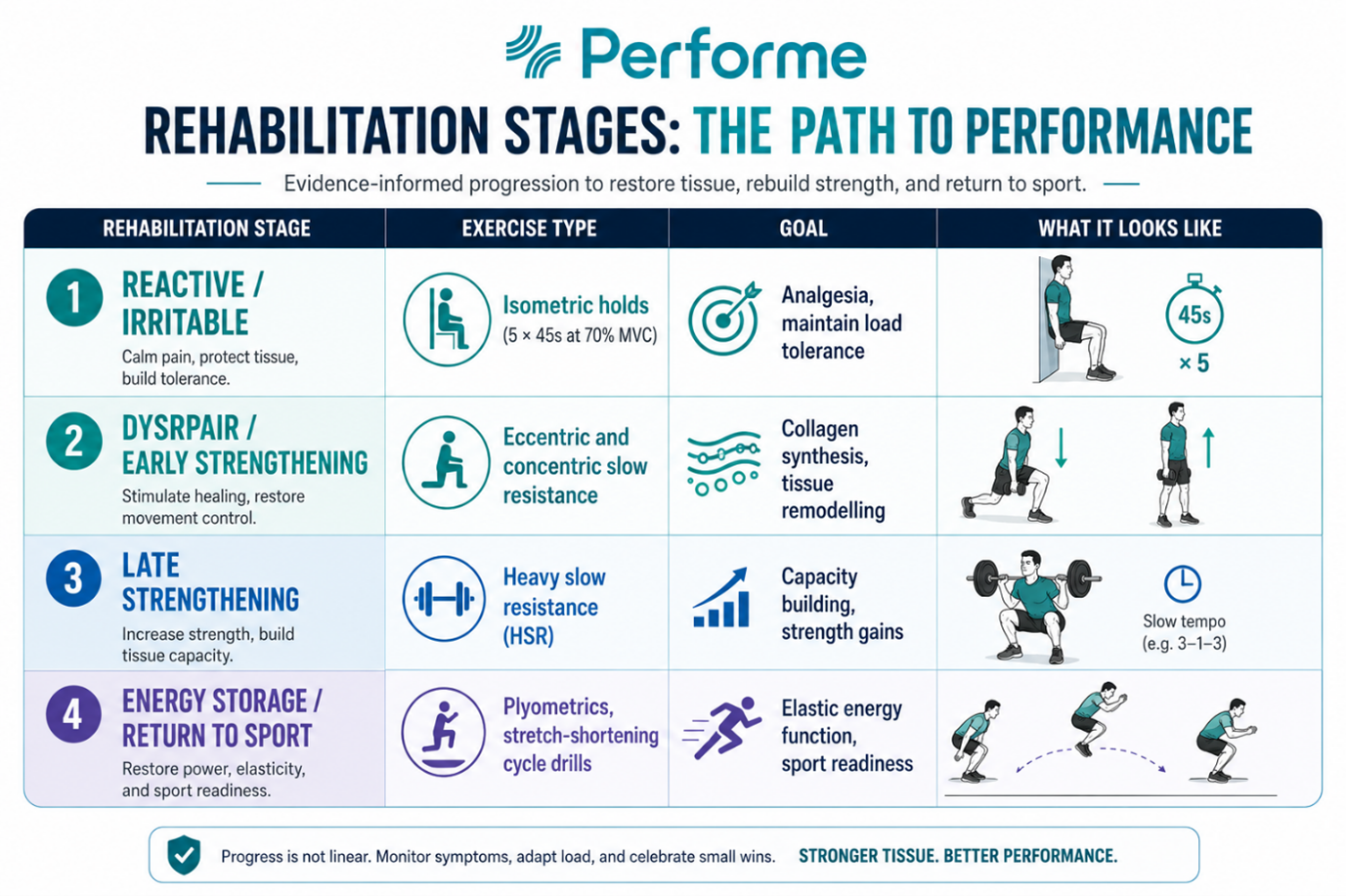
Isometric contractions - sustained holds against resistance with no change in muscle length are now widely supported as the first loading tool in tendon rehabilitation, particularly during reactive or irritable phases when movement-based loading is too provocative.
Research published in the British Journal of Sports Medicine by demonstrated that isometric exercise induces significant and immediate analgesia in patellar tendinopathy (Rio et al., 2015). A protocol of five 45-second isometric wall-sit holds reduced pain from an average of 7.0/10 to just 0.17/10. Critically, this reduction was associated with a simultaneous decrease in cortical inhibition - a measurable suppression of the motor cortex in the brain that impairs the muscle activation patterns required for normal tendon loading. Isotonic exercise, by contrast, reduced pain to only 3.75/10 and produced no significant effect on cortical inhibition.
This finding reframed tendinopathy as a condition involving central nervous system changes, altered corticospinal drive, deficits in voluntary motor activation, and brain-level contributors to persistent symptoms - not simply a tissue-level structural problem. It also reinforced why structural imaging alone is a poor guide to management: tendon abnormalities on MRI and ultrasound are frequently found in completely asymptomatic individuals, making functional, load-based assessment far more clinically meaningful.
In practice, five 45-second isometric contractions at 70% of maximal voluntary contraction are supported for their immediate analgesic effect, making this approach particularly valuable for in-season athletes who need to train and compete through symptoms while protecting an irritable tendon from further provocation.
Concentric and Eccentric Loading: Building Tissue Capacity
As the reactive phase settles and pain becomes more manageable, the rehabilitation focus shifts toward isotonic loading - combining both concentric (muscle shortening) and eccentric (muscle lengthening) contractions. Eccentric exercise dominated the field for decades, with the Alfredson protocol - 180 slow, isolated eccentric repetitions daily - producing well-documented improvements in Achilles tendinopathy. However, more recent research has directly challenged this single-modality approach.
Heavy slow resistance (HSR) training - combining concentric and eccentric contractions performed slowly under significant load - has been shown to produce outcomes equivalent to or better than isolated eccentric training, with notably superior patient adherence. The key mechanism across loading modes appears to be the magnitude of mechanical stimulus applied to the tendon, not the specific direction of contraction. Eccentric loading does stimulate peritendinous type I collagen synthesis, supporting structural remodelling, but this effect is not exclusive to eccentric exercise when load is sufficiently high. Systematic reviews of isometric, eccentric, and HSR exercise across both patellar and Achilles tendinopathy have confirmed all three modalities effective for reducing pain and improving function when dosed appropriately within a pain-monitoring framework.
The clinical takeaway is straightforward: the type of contraction matters less than the quality of load application. A well-dosed HSR programme that a patient will actually perform consistently will outperform a theoretically superior protocol that generates poor adherence or excessive pain provocation.
The Missing Link: Plyometric Training and Return to Sport
This is where rehabilitation most commonly falls short, and where athletes most commonly re-injure. Tendons are not simply passive force transmitters. They are remarkable elastic structures capable of storing and releasing energy, functioning like a stiff spring during dynamic activities such as running, jumping, and change of direction. This capacity - the stretch-shortening cycle - is precisely what makes tendons so valuable in sport, and precisely what is disrupted by tendinopathy and the pain that accompanies it.
Pain inhibits the tendon's ability to utilise elastic energy storage and release, directly compromising athletic function and performance. Patients with tendinopathy display measurably impaired reactive strength during hopping and bounding tasks even after strength-based rehabilitation has been completed and pain has resolved during resistance training. This means that a tendon tested through slow, controlled loading may appear ready for return to sport when it is not yet prepared for the rapid, high-force demands that competition places on it.
Structured plyometric training elicits distinct tendon adaptations - including improved collagen synthesis, enhanced tendon stiffness, and improved energy storage and release capacity - that are simply not achievable through slow resistance training alone. These adaptations must be deliberately trained in the later stages of rehabilitation before the athlete returns to full sporting activity.
The recommended progression for energy storage exercises follows a logical sequence:

Throughout this phase, the same pain monitoring principles that guide earlier rehabilitation continue to apply. The tendon must be progressively challenged, not abruptly exposed to forces it has not been systematically prepared for.
Putting It All Together
Tendinopathy rehabilitation is not a single exercise, but rather a staged, load-progressive journey grounded in tissue biology and pain neuroscience. Each phase builds the tendon's capacity for the next, and skipping stages, particularly the plyometric phase, is the most common reason athletes return to clinic after an apparently successful rehabilitation.
The athlete who skips plyometric progression and returns to sport on strength alone is the athlete who re-presents six weeks later. Tendons need to be taught to spring, and this takes time, progressively increased load, and respect for the biology.
The question for any clinician managing an active patient with tendon pain is no longer "should I load this tendon?" The evidence has settled that. The question is: how much, what type, and when? If you are managing a tendon injury and want a structured, evidence-based rehab plan, our sports physiotherapy Melbourne team at Performe can guide you through every stage of your recovery.
References
- Cook, J. L., & Purdam, C. R. (2009). Is tendon pathology a continuum? A pathology model to explain the clinical presentation of load-induced tendinopathy. British Journal of Sports Medicine, 43(6), 409–416. Cook & Purdam, 2009, British Journal of Sports Medicine
- Cook, J. L., Rio, E., Purdam, C. R., & Docking, S. I. (2016). Revisiting the continuum model of tendon pathology: What is its merit in clinical practice and research? British Journal of Sports Medicine, 50(19), 1187–1191. Cook et al., 2016, British Journal of Sports Medicine
- Malliaras, P., Barton, C. J., Reeves, N. D., & Langberg, H. (2013). Achilles and patellar tendinopathy loading programmes: A systematic review comparing clinical outcomes and identifying potential mechanisms for effectiveness. Sports Medicine, 43(4), 267–286. Malliaras et al., 2013, Sports Medicine
- Malliaras, P., et al. (2025). Exercise parameters to consider for Achilles tendinopathy. British Journal of Sports Medicine. Malliaras et al., 2025, British Journal of Sports Medicine
- Rio, E., Kidgell, D., Purdam, C., Gaida, J., Moseley, G. L., Pearce, A. J., & Cook, J. (2015). Isometric exercise induces analgesia and reduces inhibition in patellar tendinopathy. British Journal of Sports Medicine, 49(19), 1277–1283. Rio et al., 2015, British Journal of Sports Medicine
- Lim, H. Y., & Wong, S. H. (2018). Effects of isometric, eccentric, or heavy slow resistance exercises on pain and function in individuals with patellar tendinopathy: A systematic review. Physiotherapy Research International, 23(4), e1721. Lim & Wong, 2018, Physiotherapy Research International
- Rousseau, R., et al. (2022). Systematic review and meta-analyses comparing exercise loading protocols for mid-portion Achilles tendinopathy. BMJ Open Sport & Exercise Medicine, 8(3). Rousseau et al., 2022, BMJ Open Sport & Exercise Medicine
- Sprague, A. L., Smith, A. H., Knox, P., Pohlig, R. T., & Silbernagel, K. G. (2021). A criteria-based rehabilitation program for chronic mid-portion Achilles tendinopathy. BMC Musculoskeletal Disorders, 22(1). Sprague et al., 2021, BMC Musculoskeletal Disorders